Linear Embellishing Harmonies (Six-Four chords)
Linear Embellishing What Now?
This lesson is about a new class of chord that we call Linear Embellishing Harmonies.
Look at the two examples above.
The first chord (I6) changes inversions and becomes a root position I chord. On the way there, the composer simultaneously uses a neighbor tone in the alto and passing tones in the soprano and bass. This creates an interesting situation: the second chord is then composed entirely of non-harmonic tones.
It also creates a problem. If you "add up" the notes, it looks like a ii chord. But as we know, the function of a ii chord is to go to V. This one, however, does not go to V.
The same thing occurs in the second example, except they aren't circled or labeled as such. Motion between ii6 and ii via simultaneous non-harmonic tones. If you look at the three notes though, they almost add up to an E minor chord, which would be labeled as iii in C major.
Chords that are better understood as simultaneous non-harmonic tones rather than functional chords are referred to as Linear Harmonies.
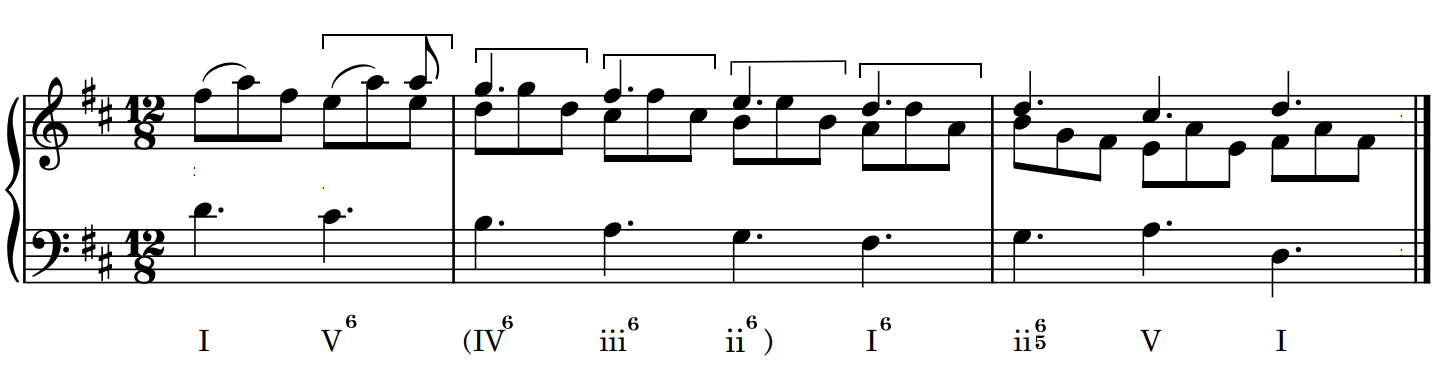
They may occur in many situations. Here are a couple of more extreme examples.
Linear Harmonies
A linear harmony is defined as an incidental harmony which is a product of voice leading. In the examples above, there was a clear goal: smooth motion between two chords.
Another way to say it: a chord that is better understood as a collection of non-harmonic tones which look like a chord which exists, but does not function like the roman numeral would suggest.
These harmonies exist to embellish, the same way a non-harmonic tone embellishes a chord, a linear harmony embellishes a chord progression. It is doing the same job, but on a different layer.
We indicate that we are interpreting a chord as a linear harmony by using brackets: [ii]
In otherwords, they are fakes. So we put them in jail.
How does this relate to six-four chords?
As it turns out, all six-four chords are linear harmonies. Anytime you see a six-four chord, it is not functioning like its root-position counterpart. It is always embellishing the chords around it. But why?
Note: ANY chord can be used as a linear harmony, but ALL six-four chords are linear.
Function
Triads in second inversion are unstable and do not function like the root position form does. But, maybe we should define what function means.
In tonal music, all chords exist to fulfill some role. The tonic harmony exists as a goal, the dominant harmony wants to resolve to tonic, and predominant chords want to move to dominant chords.
It also so happens chords exhibit their function at different strengths. For example, ii has a stronger pull to V than the IV chord, which is stronger than the vi chord, which is much stronger than the iii chord.
This is why it's odd for a ii chord to go to a I chord in the example above. It is not fulfilling its usual role.
So how does this relate to the topic at hand? Changing inversions changes the strength of a chord
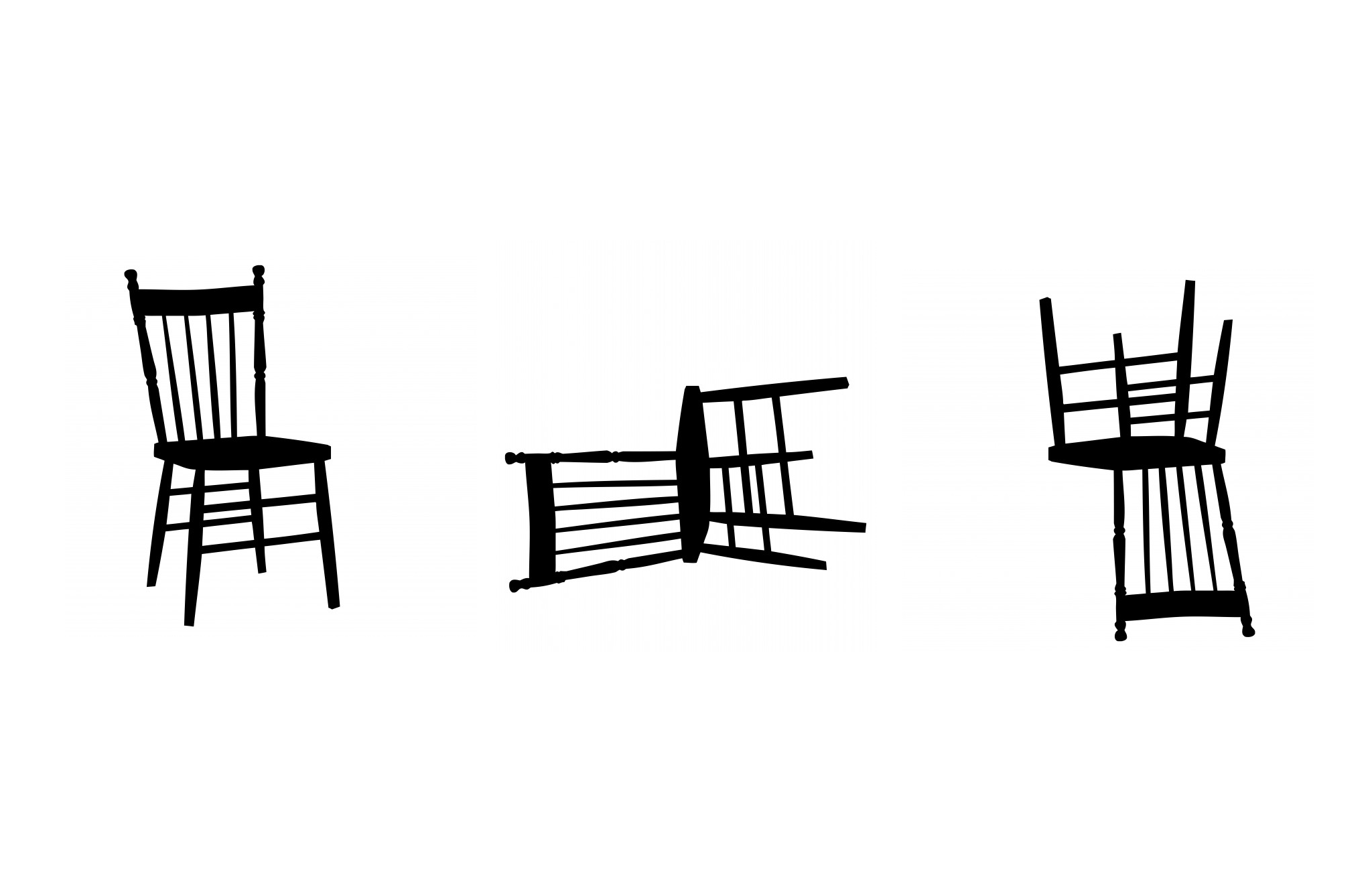
Look at the image above: the same chair in three different orientations.
The chair on the left is in its normal, intended orientation. The function of the chair is obvious, and it can easily be used as intended.
Rotating the chair and placing it on its side (the middle example) makes it harder to use. The function is still there, the chair is stable, but it isn't as easy or as comfortable to sit on as the chair like this. This hurts the chair.
Rotating it again so the chair is completely upside down, the function of the chair is completely lost. It would be an uncomfortable sitting experience that hurts both the human and the chair, and it is a stability nightmare. The third chair is useless for its intended function.
This is, as you likely suspected, analogous to inverting a chord. The chair on the left is in "root position." It is in the intended orientation and can fulfill its job perfectly well. The middle chair is in "first inversion." It can still get the job done, but its slightly less stable, and slightly less comfortable. The chair on the right would then be in "second inversion." The function is essentially lost, and its completely unstable.
Categories of Six-Four Chords
We categorize six-four chords (and linear chords in general) into four generic categories, only three of which are useful. There are likely other configurations possible, but these are by far the most common ways you will see six-four chords.
Neighbor (Pedal) Six-Four Chords
- A neighbor chord will have neighbor tone motion in two voices.
- The bass voice and one other voice will be static. Because the bass does not move, these are sometime called pedal six-four chords.
- Neighbor six-four chords are unaccented.
- Notice that the neighbor chord in both examples is a fourth higher. These should be labed with n.c
This example shows a textbook neighbor six-four chord. Two voices are sustained (both on Do), and the other two voices move to an upper neighbor tone and return. This example shows another common neighbor six-four chord. Again, two voices are sustained (both on Do), and the other two voices move to an upper neighbor tone and return. This is how they all look. All of them. This is also how they should look in your part-writing examples.
Passing Six-Four Chords
- Passing six-four chords feature passing motion in the bass.
- There is no required pattern for the remaining pitches like there is in the neighbor six-four chord.
- Passing six-four chords are usually unaccented. Also, notice that the passing chord in both examples is a fifth higher.
- These should be labeled with a p.c.
In this example notice the passing motion in the bass. There isn't much else to say, but there are two other things we can learn from this.
Same notes, different voices
First, you'll notice that in this version, while the bass goes Mi-Re-Do, an upper voice goes the opposite direction Do-Re-Mi.
The other two voices are Do-Ti-Do and Sol-Sol-Sol.
Look at the next example.
You'll notice the same four patterns are present here
The Bass has Do-Re-Mi The Alto goes in the opposite direction: Mi-Re-Do The soprano has Sol-Sol-Sol this time The Tenor has Do-Ti-Do.
These are the same four patterns, they just switched voices! This is extremely common and (if you pay attention to your part-writings and analyses) you'll notice this with a lot of chord patterns.
Also notice that this is still a passing six-four chord because there is still passing motion in bass between the I and I6 chords.
Appogiatura/Suspension Six-Four Chords
When composers combine several appogiaturas or suspensions, the result may be a six-four chord.
Labeling these can be messy. As seen in the first example below, sometimes only one note could be seen as an appogiatura, or in the second example. Also in the first example, one of those notes is clearly a neighbor tone, so it isn't always perfect. Use your best judgement, or just use APP/SUS
Really, this is a catch-all category of chords that are intended to resolve in the upper voices (usually down), but keep the bass voice static.
Note that the cadential six-four chord is a special type of this category.
Double the Bass
You may also notice that in every example of a six-four chord so far, there was a consistent doubling pattern.
In a six-four chord, you must always double the bass note. Always.
There are some good reasons for this, but nothing worth getting into now. Just know that you must always double that note, or it is considered incorrect. It doesn't work right.
When you work the examples below, you will be required to double the bass on any second-inversion harmony.