Non-Harmonic Tones
What are Non-Harmonic Tones?
A harmonic tone is any note that is part of the currently active harmony. C is a harmonic tone in a C major triad.
A non-harmonic tone is any note present which does not belong to the governing harmony.
Remember, the governing harmony is the harmony functioning at the moment in the music. If a pitch does not belong to that harmony it is a non-harmonic tone. NHTs are extremely common and equally important to harmonic tones.
These appear in many common patterns in music and have been used for hundreds, if not thousands of years. This chapter will discuss the passing tone, neighbor tone, appoggiatura, suspension, escape tone, anticipation, and pedal tone. These are all specific types of non-harmonic tones.
Things to Remember
An important thing to notice: every definition below discusses NHTs within the context of harmonic tones. Non-harmonic tones are always discussed in how they are approached (or prepared) and resolved. The examples below should explain this clearly.
By definition, they are dissonant. Dissonance make music exciting, dramatic, and graceful, and are used in many ways. Learning about NHTs means understanding the crucial role of dissonance in music. **For the remainder of the lesson, I will refer to harmonic tones as consonant and non-harmonic tones as dissonant. **
Types of Non-Harmonic Tones
Passing Tone
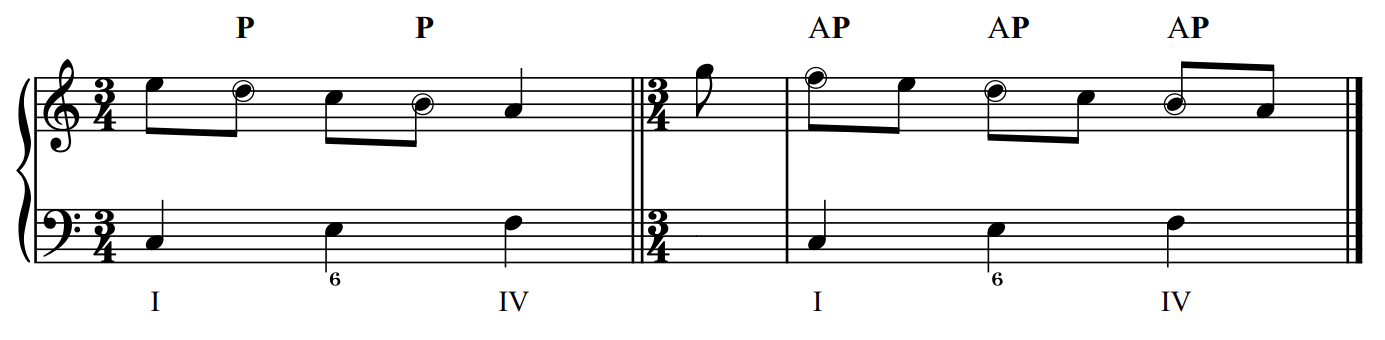
- A passing tone is a dissonant pitch which occurs between two consonant pitches.
- The dissonant note is approached by step and resolves by step in the same direction it was approached.
- Passing tones may be unaccented (metrically unstressed) or accented (meterically stressed)
- In analysis, a passing tone may be circled and marked with a P if unaccented, and AP if accented
This note is called a passing tone because it passes between two consonant pitches. It is extremely common.
Neighbor Tone
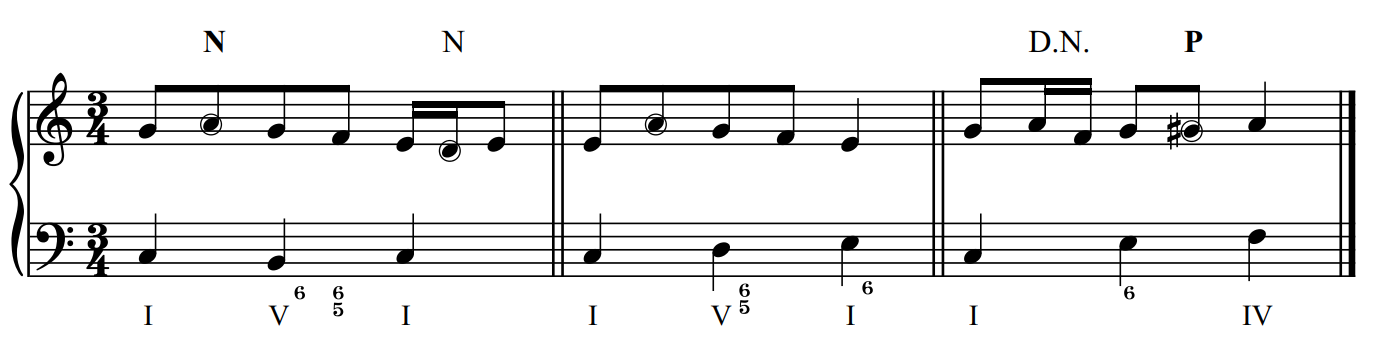
- The neighbor tone (also known as an auxillary tone) lies above or below a stable pitch
- Neighbor tones are** approached by step** and** resolved by step in the opposite direction**.
- A neighbor tone above a stable pitch is called an upper neighbor, and below a lower neighbor.
- In analysis, a neighbor tone should be circled and labled with an N, no matter the direction.
One special situation: Sometimes, there will be an upper neighbor followed by a lower neighbor. This is a Double Neighbor. I've also heard this called a cambiata. This is seen in m. 3 below
Another special situation: Sometimes, the neighbor tone will show up first and have no obvious approach/resolution (see the A in m.2 below). More on this soon.
Appoggiatura
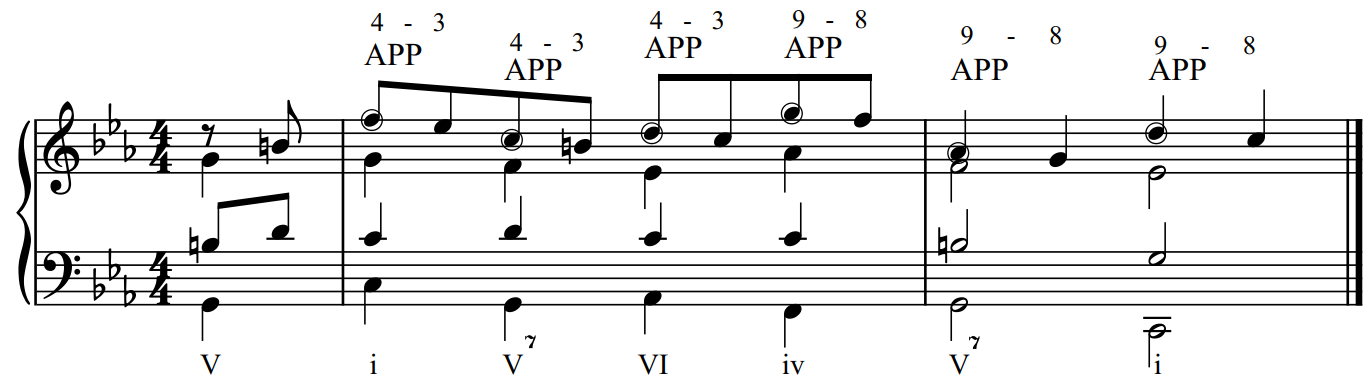
- Appoggiaturas ("leaning notes") are accented dissonances that are a striking tension and release.
- They are approached by leap and resolved by step, usually in the opposite direction.
- In analysis, appogiaturas should be circled and labled APP and with figures that indicate the distance of the appogiatura and the note of resolution to the bass note. The figures may be shown in the bass
A special situation: When unaccented, appogiaturas may called free neighbor tones (labeled with an N). This is also seen in the example above, in m. 2!
Note: when labeling these, remember that it is the distance between the appogiatura and the BASS, not the ROOT.
Suspension
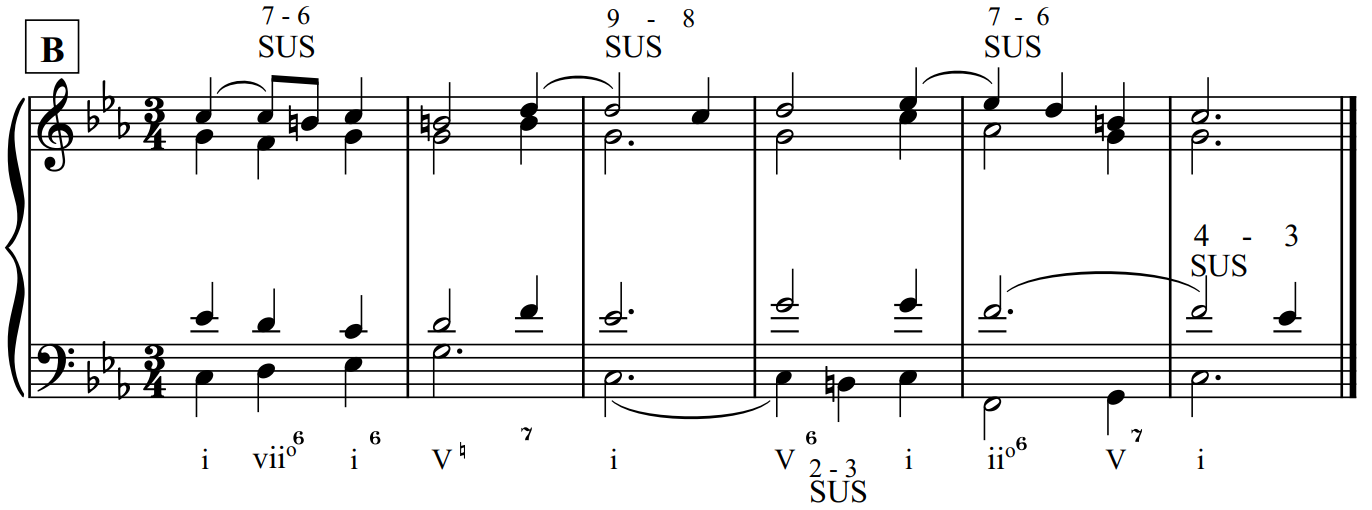
- Suspensions are extremely common accented dissonances that create a great deal of tension by sustaining a note
- The suspension takes place in three stages Stage 1, Prepare: a consonant note prepares the dissonance to be held by common tone Stage 2, Suspend: the prepared pitch is held (with a tie or a dot) while the bass moves Stage 3, Resolve: the dissonance resolves downward by step to a consonant note
- Suspensions are labeled by their distance above the bass note (not the root). Common suspensions are 4-3, 7-6, and 9-8. A suspension in the bass is called a 2-3 suspension. A suspension that resolves upwards is a retardation.
- In analysis, suspensions must be labeled with SUS and the appropriate figures. The figures may also be present in the bass.
Anticipation
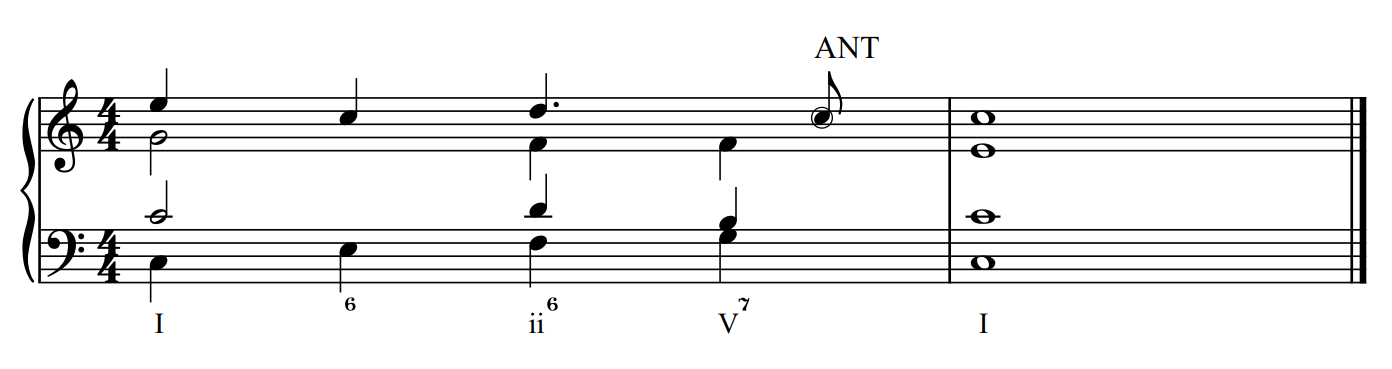
- An anticipation is an unaccented NHT that appears before the chord to which it belongs sounds. Think of it as the opposite of a suspension. A suspension hangs over, an anticipation arrives early.
- Anticipations most commonly happen at cadences.
- In analysis, circle an anticipation and label it with ANT
Pedal Tone
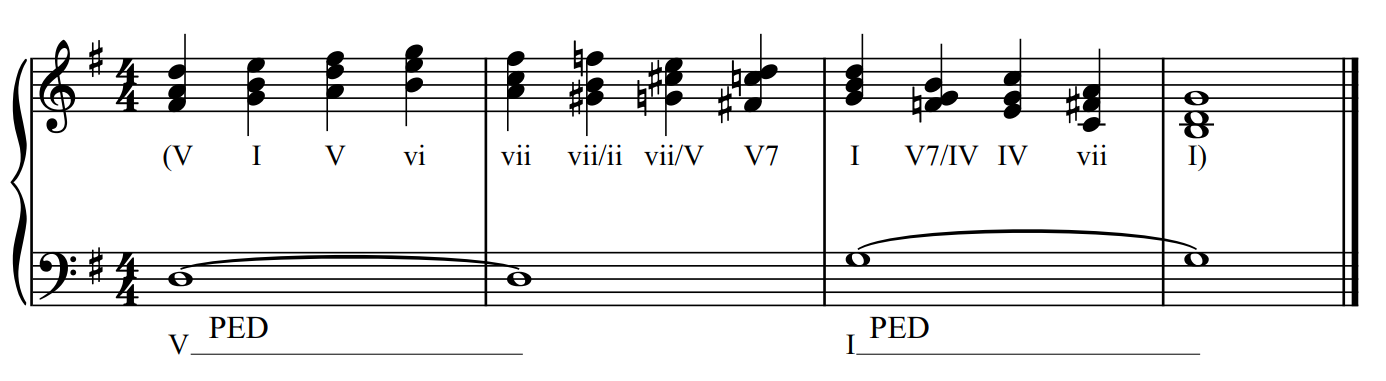
- A pedal tone is a long sustained tone, usually in the bass. It prolongs a certain harmony, typically tonic or dominant)
- The harmonies above a pedal tone will usually be subordinate to the pedal tone.
- In analysis, label the pedal tone with PED. The roman numeral will be the function that the pedal tone is prolonging. The harmonies above the pedal may be analyzed in parenthesis in root position, as shown below
Some special rules that will pop up
- The seventh of a V7 chord should never be analyzed as a non-harmonic tone
- There may be some clearly non-harmonic tones that do NOT match any of the categories above. We cannot possibly label every pattern that would exist, but understanding that they are non-harmonic tones is still important.
Examples for Analysis
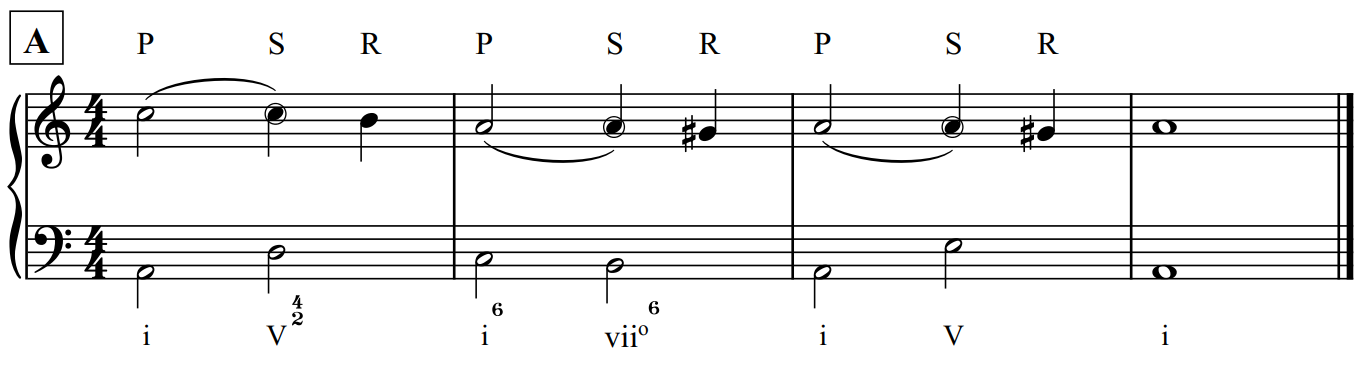
In the examples below, highlight and label any nonharmonic tones appropriately. Use the following guidelines:
- Perform a Roman Numeral analysis understanding that not every note will contribute to the harmony's name.
- Circle any non-harmonic tones. Think of the roman numeral you wrote as a "zone." Within that zone any chord that is not explicitly part of the chord you wrote is a NHT.
- For each one of those notes you circled, decide if one of the labels we learned applies to it and label it appropriately (including the relevant numbers for appogiaturas and suspensions)
- Listen back to your analysis and see if you can hear the notes you marked.