Prerequisites
Before we discuss non-harmonic tones and Linear Embellishing Harmonies, there are a few concepts I want to be in the back of your mind in this course.
Harmony as a Background Layer

In this course (and in all of your musical thinking) it will be helpful to think of music as multi-layered. I offer the following mental model:
The music we see on the page is a single layer of notes, rhythms, harmonies, and other markings. Understanding it as a single layer, however, is an over-simplifiction.
Just as a shadow of a sculpture cannot show the detail of the art, of a photograph of you cannot possibly capture your entire personality, every piece of music you hear has more layers to it that are not always immediately audible, visible, or obvious in their intention or importance.
Other layers consist of things like harmony, rhythm and meter, phrase design, harmonic function, sequential function, and many other things. The reference image has three, but there are many layers to consider.
The most important layer to consider is harmony. You may immediately think of this layer as the chords which accompany the music. But, there is more to it.
**Harmony as a layer is always present, even if there is no written harmony. **
In fact, you may eventually understand it as multiple layers (this might make more sense in the next lesson). This is a very important consideration for analyis and for understanding how music really works and why we do some of the things that we do in this course.
We will encounter this as a relevant issue in chapter 1, especially when understanding and labeling chords in second inversion (6/4 chords).
By the end of this course I want you to understand how multiple harmonic functions could even compete to be the governing harmony for a part of the music and how the harmony with the strongest function wins out. One example, a iii6 chord is so weak that the Sol in the bass completely overpowers it and our brain instead hears a V chord rather than a Mediant chord.
We will explore this more throughout this course, but for now, take away this: Every measure of music you see has a harmony which governs it, even if you do not see or hear it. This layer is created by the melody, the accompaniment, the context, and our personal understanding of the music.
Consonance and Dissonance
Another important thing to remember is the idea of consonance and dissonance in music. You likely remember from your earlier studies that consonance and dissonance are essentially pleasing and unpleasing combinations of notes.
I offer several ideas below that may be helpful in growing your understanding of consonance and dissonance.
Stability
Consonance and Dissonance may refer to how stable a sounding harmony is.
A stable harmony is one which carries no tension. A perfectly stable harmony is one which you would feel comfortable hearing as the final harmony in a piece.
An unstable harmony is one which has some degree of tension. An unstable harmony wants to resolve, and the more unstable it is, the more strict its resolution will be.
However, a perfectly pleasing harmony may be dissonant. Consider the dominant 7th chord with an internal tritone (between Ti and Fa. This is an inherently unstable harmony that has preferences about how it resolves. The leading tone is magnetically attracted to tonic, and the tall chord wants to fall from the top down (the seventh must fall). We'll return to this idea when we talk about linear-embellishing harmonies.
Function at multiple levels
Another consideration, a harmony may be dissonant in one way, but consonant in another.
Consider the subdominant harmony. This is a consonant chord. Unless there are non-harmonic tones added to it, on its surface it is a perfectly consonant harmony.
The sound of the chord is stable, at the surface. But if you consider the harmonic background layer discussed above, a subdominant harmony is unstable (albeit, mildly). The function of the chord is unstable. It is a pre-dominant harmony and its only goal in life is to eventually find its way to a dominant chord.
Consonance and Dissonance as Members of a Harmony
A more important definition for this concept relates to the concept we just saw above. A note is consonant if it belongs to the governing harmony, and dissonant if it does not. This means, if it is in the roman numeral used to analyze the harmony, it is consonant. If not, it is dissonant.
The Natural Order of Things
Another concept you may or may not be familiar with is a chord's function. This is a big part of this course but I will touch on what that means here.
First, there are three generic functions of chords, seen below
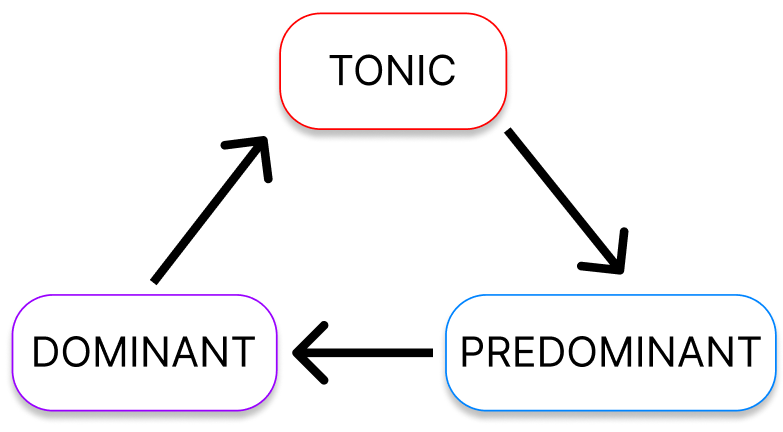
These three generic functions govern every tonal piece of music you've ever heard in some way. A piece of made up of many musical phrases. Each of those phrases is made up of chords that function in one of these three ways.
Tonic -> Predominant -> Dominant -> Tonic
In real music, this model is imbalanced, however. A proportionate chart would look like this:
Tonic-------------------------------------------------------------------------------------------------------------> Predominant --> Dominant -> Tonic
You'll find that chord progressions hang out around Tonic for a while before moving on to the other two functions.
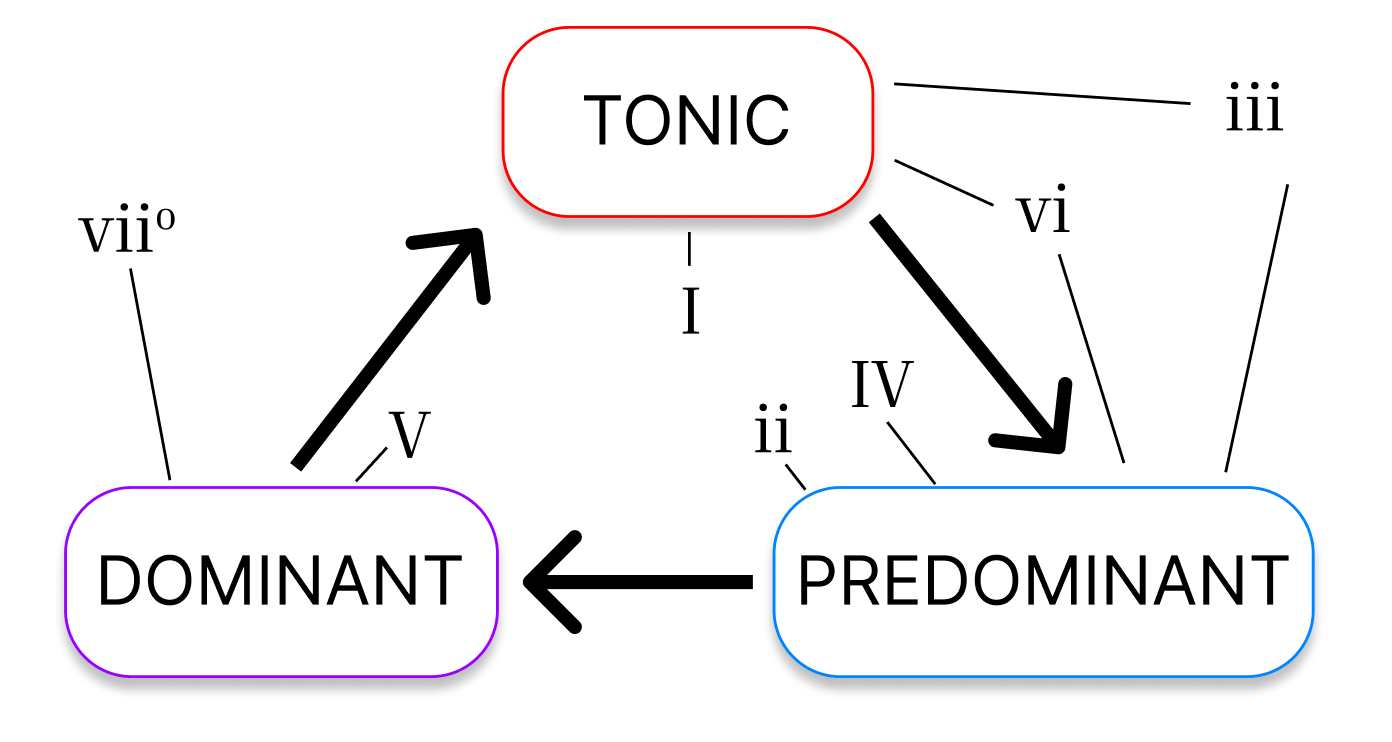
You can also assign each chord to one of these three functions (though as we'll learn, it's less about the chord and more about the note in the bass. Do, Fa, and Sol are the important notes, not I IV and V).
See the chart above, in the chart above, a shorter line distance to the given function should indicate a chord's relative strength of that function. The chords you learned in Music Theory I (I, IV, V, and ii) have very clearly defined functions. The chords we will learn in Music Theory II (vi, iii, and vii) you can see have weaker or even dual functions.
We will return to this later in this course, but for now, it should be in the back of your mind.